How to Know Your Septic Tank Needs Pumping Before It Backs Up
The three to five year rule is real, but it's not the only clock running on your tank.
September 9, 2026 · 4 min read
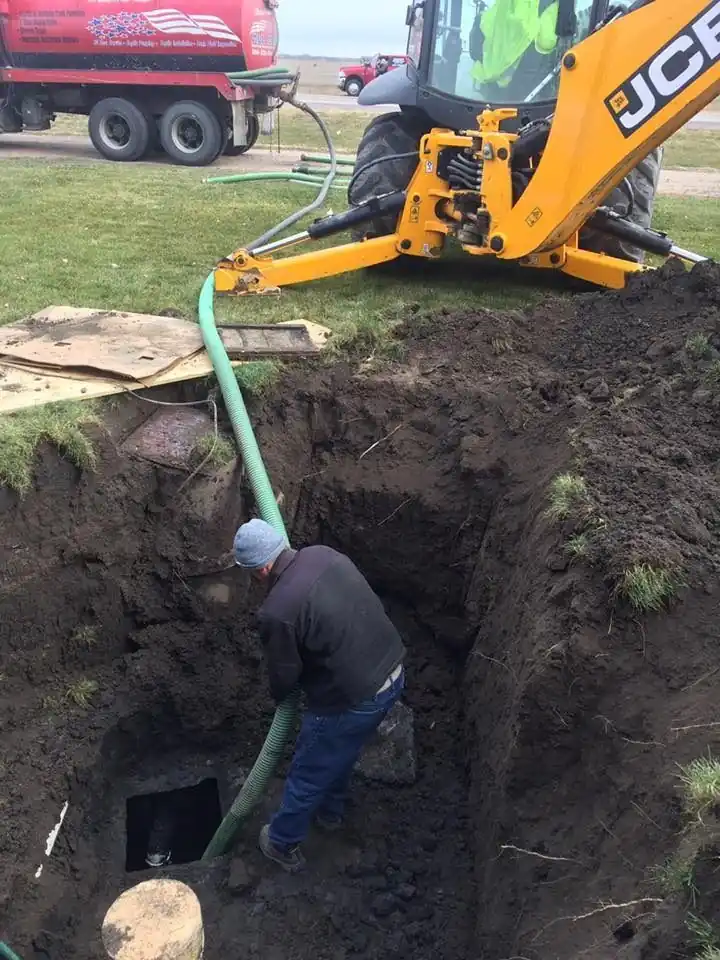
Most people find out their septic tank needs pumping the same way: something backs up in the house, usually the lowest drain, usually on a weekend. By then the tank has already told you everything it can tell you through a pipe, and the fix has gone from a routine visit to an emergency call. There's an easier way to stay ahead of it, and it starts with understanding what actually fills a septic tank up.
Why three to five years, specifically
We tell people to plan on having their tank pumped every three to five years, and that range isn't marketing. It's the window where most household tanks, sized for a typical family, build up enough solid waste in the bottom and enough scum on top to start eating into the working capacity of the tank. Every time water enters the tank, it displaces liquid out toward the drain field. The solids that don't break down stay behind. Over years, that layer thickens, and the tank has less and less clear space for wastewater to sit and settle before it moves on.
The interval isn't fixed the same for every house. A tank serving two people who are careful about what goes down the drain can sometimes stretch toward the far end of that window. A tank serving a bigger household, or one that's undersized for the number of people using it, can fill faster and needs checking sooner. The number is a starting point, not a guarantee.
What's actually setting the clock
Sludge depth is the real trigger, not the calendar. When the solid layer at the bottom of the tank gets thick enough, it starts getting close to the outlet pipe that feeds your drain field. Once solids start moving out of the tank and into the field, they clog the soil around the field lines, and that kind of damage doesn't reverse with a pumping. It's the difference between a job that takes an hour and one that means digging up and replacing a drain field. That's the whole reason the interval exists: pump the tank before the sludge line gets anywhere near the outlet, and the field never sees solids at all.
A few things push that timeline in either direction. A garbage disposal sends more solid material into the tank than a household without one. A water softener or heavy laundry use adds more liquid volume moving through the system. Older cast concrete tanks and newer poly tanks hold up differently over time, and a tank that's been neglected for a decade tends to need more than one visit to get back to a normal maintenance rhythm.
Signs the tank is telling you something now
Slow drains throughout the house, not just one fixture, is usually the first real sign. If your kitchen sink, your shower, and your washing machine are all draining slower than they used to, at roughly the same time, that points at the tank rather than a single clogged pipe. A soggy patch of yard over the tank or the drain field, especially one that stays wet when nothing around it does, is another. So is a sewage smell near the tank lid or out by the field on a still day. None of these are subtle once you know to look for them, but most homeowners never connect them to the tank because nothing has actually backed up in the house yet.
By the time a drain backs up indoors, the tank has usually been full for a while. That's not a comfortable thing to hear, but it's the honest version: the visible symptoms show up late, after the tank has already lost most of its working capacity.
What a scheduled pumping actually buys you
We run a maintenance program for exactly this reason. A tank on a schedule gets pumped before the sludge line becomes a problem, which means the field never takes on solids it wasn't built to handle. It also means we're in the tank on a predictable basis, which is when we check the baffles, the inlet and outlet, and whether the field is still absorbing water the way it should. A Saturday emergency call doesn't give anyone time for that kind of look. A scheduled visit does.
We've been doing this work in Kearney and across Central Nebraska since 1997, and between our team we've got more than 75 years of hands on experience with septic systems specifically, not general plumbing tacked onto a septic license. If it's been a while since your tank was pumped, or you're not sure when it last was, that's worth a call before it turns into a weekend problem. We offer free estimates, work within a 60 mile radius of Kearney, and we're licensed with the Nebraska Department of Environment and Energy as master septic installers and pumpers, NDEE #C1235. For anyone on acreage or a farm property running a septic system instead of city sewer, staying ahead of the pump schedule matters even more, since a field failure out there usually means a longer, more expensive fix than it would in town.
All American Sewer & Drain, LLC, (877) 221-1856
Call (877) 221-1856More articles
Tree Roots in Your Sewer Line: How They Get In and What Actually Clears Them
A root doesn't break into a pipe. It finds a place the pipe was already open.
Frozen and Burst Pipes on the Plains: What to Watch For and What to Do First
By the time you can see the damage, the water's usually been moving for a while.